
Special imaging techniques

As well as digital photography, Imaging Services offer a range of specialist imaging services. Descriptions of the recording techniques which we provide, their typical use-cases and their cost are detailed below.  Recording collections material using special imaging techniques requires the permission of the Bodleian Library’s curators.

Photometric stereo: recording the three-dimensional surface of library and gallery material
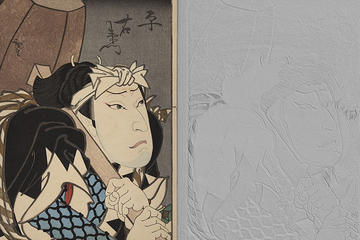
Two versions of a painting; one is in full colour, while the other is in relief against a grey backround

Photometric stereo is an extremely effective and efficient method for recording high resolution 3D data from low relief originals. Four images of the original are captured from a static position, each illuminated at 90 degrees from the previous capture. Through determining the position of highlights and shadows in these four images, software is used to create texture maps, which encode the angle and relative height of the original at each pixel. These texture maps can be used to create renders which reveal the surface of the original through shading and without the distraction of the original’s tone or colour. Renders can be digitally relit and examined from any angle or height as if shining a torch across the surface of a plaster impression of the original. Both the 3D surface and the colour of the original are captured in the same recording.

The Bodleian Library’s photometric stereo recording system, Selene, was designed and made by the Factum Foundation. It was the first of its kind and has been used extensively since 2022 as part of a collaborative project called ARCHiOx (Analysis and Recording of Cultural Heritage in Oxford). The project has received the generous funding support of the Helen Hamlyn Trust.

Read more about ARCHiOx:

What photometric stereo imaging can be used for

 
Stylus incisions, piercing and pouncing marks in the surface of artworks and manuscripts reveal evidence of preparatory stages in their production or as a method for copying designs. These markings are often so narrow and shallow that they are impossible to capture in a conventional photograph, but photometric stereo is very effective in revealing them. Photometric stereo recording has been used to record hundreds of annotations in stylus from the margins of medieval manuscripts.

 
This technique can be extremely effective at revealing watermarks. This is especially useful in cases where transmitted light or radiography cannot be used. The structure of the paper can also be assessed. Renders made using this technique are capable of revealing the impression from the printing block or plate into the paper and in some cases, reveal regions of reworking.

 
Copper printing plates from the 17th and 18th centuries which have not undergone restoration are likely to have become discoloured thorough decay. Using this imaging technique, it is possible to reveal the original design with more clarity than conventional photography.

 
Photometric stereo imaging has several advantages over raked light photography and is typically more effective at revealing brush stokes and pigment layers in paintings, especially in dark, homogeneous regions. Photometric stereo recordings can in some cases, be used to examine the substrate on which the artwork has been made.

 
The Bodleian Library’s photometric stereo imaging system records originals at a minimum of a million pixels per square inch. The extremely high-resolution, 3D output can be used for the assessment of a number of conservation related features. These include the examination of historic repairs, insect damage and pigment loss. The height, width and depth of recorded elements can in many cases be measured. Recordings can be shared remotely with experts in other institutions.

 
Unlike many laser-based forms of 3D acquisition, photometric stereo imaging can be effective at recording the surface of originals through glass. Provided that the glass is clean and free from scratches, the surface of glass-mounted papyrus fragments and artworks which cannot be removed from their frames can be recorded.

 
Surface data captured using photometric stereo imaging can be 3D printed or milled in order to create a physical facsimile of the recorded original. Files which store the 3D data may need to be converted to a compatible format specific to the 3D printer.

What photometric stereo imaging is less effective for

 
Photometric stereo is not an appropriate recording technique for the recording of originals which have a height variation of more than 25mm or have undercuts. In these cases, photogrammetry is a preferable technique for accurately recording their surface.

 
In cases where text has been erased through rubbing the surface of the paper or parchment, it is unlikely that any depressions made by the tip of the writing tool can be recovered. The rubbed regions will appear rougher than the surrounding areas when looking at the surface render. If any traces of ink remain, it may be possible to enhance them either through the editing of a high-quality photographic image, by recording the original using multispectral imaging or in some cases by using transmitted light imaging.

 
Photometric stereo is unlikely to be successful in recovering text which has been redacted.  In many cases, the impression of the nib into the paper or parchment is likely to be extremely shallow and the ink used to make the redactions may have infilled these tiny grooves. However, if the text was written using a modern pen rather than a quill pen, or if the writer applied a good deal of force through the writing tool, it may be possible to reveal the text in a surface render. If the redactions were made using an ink of a different composition, it may be possible to use multispectral imaging to recover the hidden text. In some cases, transmitted light imaging may also be used.


Though photometric stereo imaging can be used very effectively to record metallic originals such as discoloured copper printing plates or plaquettes, if the surface of the original is highly polished, it may be difficult or impossible to record using photometric stereo.

How much does photometric stereo imaging cost?

Photometric stereo imaging is charged according to the time taken to capture and process the data and to create the final renders. Unlike traditional photography, there is no standard output. Just as the topography of each original is different, so too should be the approach used in creating the final renders. Small originals or sample areas of a larger work are relatively quick to capture and process.  For recordings of larger originals in their entirety, multiple recordings are stitched together to form the final render. This process can be complex and time-consuming.

Please note: A minimum charge of one half day will be made. Prices are exclusive of VAT, if applicable.
 

Requests from Oxford University or Bodleian Libraries staff or departments for the recording of originals held by the Bodleian Libraries or Oxford University institutions.

Requests made by students, educators and researchers affiliated to an educational institution for the recording of originals held by the Bodleian Library

Requests made by students, educators and researchers affiliated to an educational institution for the recording of originals not held by the Bodleian Library

Requests made by private owners or dealers for the recording of privately owned originals.

Photogrammetry: recording three-dimensional originals

A globe bearing an old constellation diagram; half of the globe is a matrix of grey points

Photogrammetry is a 3D recording technique used for the capture of an object’s shape, colour and reflective properties. The resulting 3D models can either be navigated digitally or used in the production of physical facsimiles. Photogrammetry models are considerably slower to capture and process and are lower resolution than photometric stereo recordings, but photogrammetry is able to capture the volume of an original rather than just its surface. A photogrammetric recording is made by photographing an original from hundreds of different positions under even illumination. The images are processed into a 3D model onto which the colour and texture is projected.

What photogrammetry can be used for

 
The Bodleian Libraries Imaging Services department specialise in the 3D capture of book and manuscript bindings. Hundreds of our 3D models have been published and can be explored in our ARCHiOx gallery.

 
Originals which weigh less than 4kg and are smaller than a shoe box can be recorded in our photographic studio. Though the capture of the original is reasonably quick, it typically takes several hours to process the images into a 3D model and associated textures. Photogrammetry recordings of small originals held by the Bodleian include letter seals and portrait busts.

 
For originals, which cannot come to the studio, recordings can sometimes be made in-situ. These may include metal or stone statues or large museum pieces. A preliminary assessment will be required in order to plan for the recording. The success of the recording will depend on the complexity of the object’s shape, the available space surrounding the object, and the ambient light falling on it.

What photogrammetry is less effective for

 
A successful recording is only possible if the shape and volume of the original remains unchanged during photography. Paperback books and manuscript with limp bindings are likely to be challenging or impossible to record successfully; and likewise, objects with flexible, hanging or draped elements. In some cases, it may be possible to produce a 3D model from these kinds of originals but with the underside remaining unrecorded.

 
Originals with jewels or glass components cannot be recorded using this technique. Highly polished metal surfaces may be challenging or impossible to record.

How much does a photogrammetry recording cost?

Photogrammetry recording is charged according to the time taken to capture and process the data and to create the final digital model. It’s important to consider how the digital model will be used.  Typically, photogrammetric models are published using an online service which allows the end-user to view, navigate and relight the model. Though Imaging Services do not offer a 3D printing service, If the intended use of the recording is for the production of a physical facsimile, we may be able to advise on a service provider which is suitable.

Please note: A minimum charge of one half day will be made. Prices are exclusive of VAT, if applicable.

Requests from Oxford University / Bodleian staff or departments for the recording of originals held by the Bodleian Library / Oxford University institutions.

Requests made by students, educators and researchers affiliated to an educational institution for the recording of originals held by the Bodleian Library

Requests made by students, educators and researchers affiliated to an educational institution for the recording of originals not held by the Bodleian Library

Requests made by private owners or dealers for the recording of privately owned originals

Transmitted light imaging: recording light passing through library and gallery material
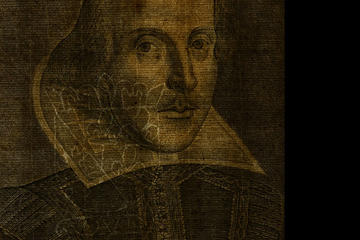
A painting of Shakespeare, darkened to show other details on top of the image

Transmitted light imaging involves the photography of an original which is lit from beneath. A thin and flexible electroluminescent light sheet is positioned underneath the document and the light transmitted through the substrate is captured.

What transmitted light imaging can be used for

 
Along with radiography, transmitted light is a commonly used technique for photographing watermarks, chain lines and laid lines in paper. The effectiveness is dependant on the change in density of the paper at the region where the watermark was made.  

 
In some cases, preparatory underdrawings can be revealed using transmitted light. The success is dependant on the composition of the substrate and the density of the ink and pigments used on both sides of the original.

 
In cases where new material has been added to an original either for the purpose of alteration or for support, these features may be revealed with additional clarity through transmitted light imaging.

 
In cases where redactions were made using an ink of a different composition, it may be possible to use multispectral imaging to recover the hidden text. In some cases, transmitted light imaging may also be used though success will depend on the density of the ink used for the redactions.

What transmitted light imaging is less effective for

 
Photometric stereo imaging is likely to yield better results.

 
Photometric stereo imaging is likely to yield better results.

How much does a transmitted light image cost?

Transmitted light imaging is charged per image. Detailed instructions will be required in order for the photographer to capture the specific region of interest. A description of what you would like the image to reveal is desirable.

  • Cost per image: £35
  • Cost for subsequent images from the same item:  £9

Macro photography: high magnification digital imaging

Macro photography involves the use of specialist lenses, lighting and digital techniques in order to capture very small originals or samples of larger originals at high magnification.  
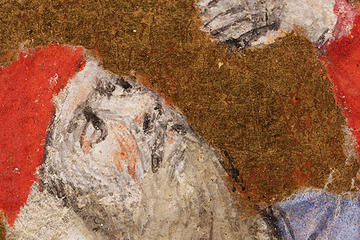
A section of a painting showing a man wearing a red hat

What can macro photography be used for

 
Cropping a digital image in order to isolate and reproduce a small detail should be avoided as the resulting image may not have sufficient resolution and could appear pixelated when reproduced. A much higher resolution image can be made by capturing  the specific region of interest. This can then be reproduced at a significantly larger than life size.

 
High resolution macro photography is supportive for the analytical study of details found in library and gallery material. Macro images may allow the researcher to examine an original’s materiality, manufacture, condition and authenticity.

How much does a macro image cost?

Macro photography is charged per image. Detailed instructions will be required in order for the photographer to capture the specific region of interest. A description of what you would like the image to reveal is desirable.

  • Cost per image: £35
  • Cost for subsequent images from the same item:  £9

Tiled photography and stitching: digitally joining multiple images captured from large or long originals
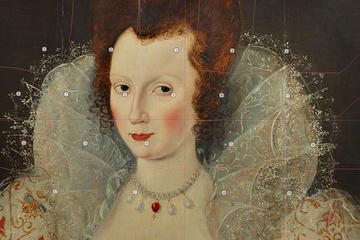
A portrait of a woman wearing a ruff and an embroidered dress; the image is covered in a matrix of dots

Where capturing material which has a challenging aspect ratio or in cases where a large original cannot be captured as a single image, it may be possible to stitch multiple image tiles together in order to create a single, high-resolution image, or mosaic.

What kinds of originals may require tiling and stitching

 
Due to their length and aspect ratio, scrolls often need to be captured by photographing multiple image tiles. The photographer will ensure that an adequate overlap between tiles is recorded. If required, these image tiles can be stitched and blended together in order to create a single, high-resolution image.

 
Originals larger than A0 (841 x 1189mm) may need to be captured in sections. If required, these sections may be stitched together to form a single, high-resolution image.

How much does a tiled image cost?

A charge will be made for each image tile captured. The number of tiles required will be determined by the dimensions and aspect ratio of the original. The number of tiles required for a specific original is calculated by the photographer prior to photography and the customer informed of the cost. An additional charge will be made for stitching the tiles together as this can be extremely complex and time-consuming.

  • Cost for first image tile: £27
  • Cost for subsequent image tiles from the same item:  £7.50
  • Additional cost for stitching: £20 per tile

Ultraviolet-reflected and ultraviolet-induced imaging: enhancing text or materials through illuminating an original with ultraviolet radiation
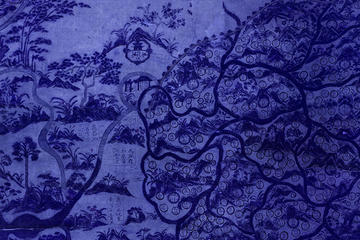
A Chinese map displayed in ultraviolet

Ultraviolet-reflected (UVR) imaging captures the reflected radiation in the ultraviolet region of the spectrum from an original which has been illuminated using ultraviolet sources. The wavelength range of both the incoming and outgoing radiation is the same. Unwanted frequencies within the spectrum are blocked through the use of filters.

Ultraviolet-induced (UVL) imaging captures the emission of light in the visible spectrum from an original illuminated with ultraviolet radiation.

What UVR and UVL imaging can be used for

 
Faded or erased text written in an ink which contains iron can in some cases be enhanced through ultraviolet imaging. Illuminated by ultraviolet radiation, regions of the manuscript page containing traces of iron are absorbed while the surrounding parchment or paper fluoresce.

 
While UVR images can be useful for revealing surface material such as varnishes, UVL imaging can be used to examine the presence of luminescent materials such as organic binders and pigments as well as some inorganic compounds.

How much does ultraviolet imaging cost?

Ultraviolet photography is charged per image. Detailed instructions will be required in order for the photographer to capture the specific region of interest. A description of what you would like the image to reveal is desirable.

  • Cost per image: £35
  • Cost for subsequent images from the same item:  £9